See ya in Columbus, suckas!
Cannot wait for this game. Should be a close fought, slugfest.
I wrote some more here.
On Wisconsin!!
Showing posts with label history. Show all posts
Showing posts with label history. Show all posts


Precedent
I have a simple message for the message board crazies out there: you're crazy.
This guy? You're partially right, but on Bielema?
Look, I don't know if Bielema is the answer. He's certainly done some things I wasn't happy with. He's done some things I was happy with, but in hindsight were wrong. He hasn't been perfect. But where all the crazies get this, "UW will never win under Bielema" from is beyond me. Seriously.
Oh, but you have numbers on your side, right? I mean look: 12-1, 9-4, 7-6. Clearly a team on the decline. Clearly Barry Alvarez's legacy is tarnished, left in tatters by a coach who doesn't know what he's doing.
Well, I'm a lawyer in my day job, so I like precedent. Let's look at some:
10-1-1 . . . 8-3-1 . . . 4-5-2. Anyone recognize that? Ok, another:
10-2 . . . 9-4 . . . 5-7. How about that one?
So what happened? In 1993 Barry led the breakout season that was a sign of things to come and was golden every year since, right? Um . . .
Returning a bunch of stars in '94 (notwithstanding Brent Moss's troubles), we started the season highly ranked (#10), got smacked around by Colorado (55-17, for those who don't recall the pain), and ended up beating #25 Duke (yeah, Duke), in the Independence Bowl (and we remained unranked). Not what we wanted, but not awful. Then it all came crashing down: 4-5-2, including another embarassing loss to Colorado (at the Camp, 43-7, we were ranked #21) and painful ties to Stanford and Illinois (the last tie in college football, and the most boring game in the history of Wisconsin football; thank God I decided Thanksgiving was more important).
That was it. '93 was a flash in the pan, and Wisconsin was back to the Morton era. Well, not quite. Ron Dayne saved the program, or that's how the script goes. In '96 we started unranked (not even receiving votes), went 8-5 but lost to all but two teams with a winning record (Utah in the Copper Bowl, and 7-5 Stanford), and finished the season unranked. In '97 we started the season #24, but after another embarassing loss (remember when Syracuse was good?) we dropped out, and ended the same way, with a brutal loss to Georgia in the Outback Bowl, finishing unranked, just as we had the prior three years (8-6 overall, beating one team with a winning record, 7-5 Iowa).
We all know what happened next: we were "the worst team ever to play in the Rose Bowl" (until we stunned national title contender UCLA), then we beat Stanford to become the only Big Ten team to ever win back-to-back Rose Bowls. And then?
That's right, we started 2000 with seemingly all the pieces in place, ranked #4 in the country, and instead went 9-4, beating a good Oregon team (10-2), but only beating two other teams with winning records (Western Michigan and pre-Big East Cincinnati; forgive me for not alerting the presses) before beating 6-6 UCLA in the Sun Bowl to finish the season at #23. Then? 5-7. And that's when people started wondering if Barry had passed his prime. The same people who are now arguing that Bielema has permanently ruined Barry's legacy and needs to go . . . now.
And it isn't as though Barry rocketed back from that 5-7 season, any more than he did from the 4-5-2 season in '95. 8-6 (losing to 3-9 Indiana and only two conference wins), 7-6 (beat a good Ohio State team, but the only other conference win over a winning team was Michigan State); that was when everyone started wondering if Barry had gone all Joe Tiller on us. The voices were loud: Barry needed to go. Then we narrowly missed the Rose Bowl in Barry's last two years, and sent him out with an epic beat down on Auburn.
Under Alvarez (of whom I'm a big fan, by the way), the Badgers finished in the top 25 only 6 times in 16 seasons, with two big gaps interspersed: '93, '98, '99, '00, '04, and '05 (see here).
So, Bielema goes 12-1 (#7), 9-4 (#24), and 7-6. Not the trajectory we like, but not without plenty of precedent from none other than "King Barry." So let's save the "trashing his legacy" talk for a little further down the road. How about we start by cheering for the Badgers and hoping (not without reason) that they have a good year. And what's the standard? Well, if we're holding up Barry's legacy, I'd go with about 8 wins against a pretty mild slate. That's what the King did.
I, for one, think we'll be a little better than that.
This guy? You're partially right, but on Bielema?
Look, I don't know if Bielema is the answer. He's certainly done some things I wasn't happy with. He's done some things I was happy with, but in hindsight were wrong. He hasn't been perfect. But where all the crazies get this, "UW will never win under Bielema" from is beyond me. Seriously.
Oh, but you have numbers on your side, right? I mean look: 12-1, 9-4, 7-6. Clearly a team on the decline. Clearly Barry Alvarez's legacy is tarnished, left in tatters by a coach who doesn't know what he's doing.
Well, I'm a lawyer in my day job, so I like precedent. Let's look at some:
10-1-1 . . . 8-3-1 . . . 4-5-2. Anyone recognize that? Ok, another:
10-2 . . . 9-4 . . . 5-7. How about that one?
So what happened? In 1993 Barry led the breakout season that was a sign of things to come and was golden every year since, right? Um . . .
Returning a bunch of stars in '94 (notwithstanding Brent Moss's troubles), we started the season highly ranked (#10), got smacked around by Colorado (55-17, for those who don't recall the pain), and ended up beating #25 Duke (yeah, Duke), in the Independence Bowl (and we remained unranked). Not what we wanted, but not awful. Then it all came crashing down: 4-5-2, including another embarassing loss to Colorado (at the Camp, 43-7, we were ranked #21) and painful ties to Stanford and Illinois (the last tie in college football, and the most boring game in the history of Wisconsin football; thank God I decided Thanksgiving was more important).
That was it. '93 was a flash in the pan, and Wisconsin was back to the Morton era. Well, not quite. Ron Dayne saved the program, or that's how the script goes. In '96 we started unranked (not even receiving votes), went 8-5 but lost to all but two teams with a winning record (Utah in the Copper Bowl, and 7-5 Stanford), and finished the season unranked. In '97 we started the season #24, but after another embarassing loss (remember when Syracuse was good?) we dropped out, and ended the same way, with a brutal loss to Georgia in the Outback Bowl, finishing unranked, just as we had the prior three years (8-6 overall, beating one team with a winning record, 7-5 Iowa).
We all know what happened next: we were "the worst team ever to play in the Rose Bowl" (until we stunned national title contender UCLA), then we beat Stanford to become the only Big Ten team to ever win back-to-back Rose Bowls. And then?
That's right, we started 2000 with seemingly all the pieces in place, ranked #4 in the country, and instead went 9-4, beating a good Oregon team (10-2), but only beating two other teams with winning records (Western Michigan and pre-Big East Cincinnati; forgive me for not alerting the presses) before beating 6-6 UCLA in the Sun Bowl to finish the season at #23. Then? 5-7. And that's when people started wondering if Barry had passed his prime. The same people who are now arguing that Bielema has permanently ruined Barry's legacy and needs to go . . . now.
And it isn't as though Barry rocketed back from that 5-7 season, any more than he did from the 4-5-2 season in '95. 8-6 (losing to 3-9 Indiana and only two conference wins), 7-6 (beat a good Ohio State team, but the only other conference win over a winning team was Michigan State); that was when everyone started wondering if Barry had gone all Joe Tiller on us. The voices were loud: Barry needed to go. Then we narrowly missed the Rose Bowl in Barry's last two years, and sent him out with an epic beat down on Auburn.
Under Alvarez (of whom I'm a big fan, by the way), the Badgers finished in the top 25 only 6 times in 16 seasons, with two big gaps interspersed: '93, '98, '99, '00, '04, and '05 (see here).
So, Bielema goes 12-1 (#7), 9-4 (#24), and 7-6. Not the trajectory we like, but not without plenty of precedent from none other than "King Barry." So let's save the "trashing his legacy" talk for a little further down the road. How about we start by cheering for the Badgers and hoping (not without reason) that they have a good year. And what's the standard? Well, if we're holding up Barry's legacy, I'd go with about 8 wins against a pretty mild slate. That's what the King did.
I, for one, think we'll be a little better than that.
If You Can't Beat 'Em . . .
Since Bielema (and probably most coaches, AD's, etc.) dislikes bloggers so much, it looks like the athletic department is trying to get into the act. This is an aggregator of sorts: linking to stories about the Badgers around the web. No links to any true bloggers yet, though. At minimum I'd vote for BadgerCentric and Bucky's 5th Quarter (ok, and me, too) for football coverage, but I won't hold my breath.
Also, UW opened a Fall Camp headquarters page. It includes the 2009 Fact Book (more or less a media guide -- there's generally a lot of good stuff in these), the present roster, and the current depth chart. Note: starting wide receivers are Isaac Anderson and Gilreath or Toon (I'm betting on Toon); strong safety is listed as Valai or Pleasant; and while Henry has one corner, the other is listed as Brinkley or Devin Smith.
Also, UW opened a Fall Camp headquarters page. It includes the 2009 Fact Book (more or less a media guide -- there's generally a lot of good stuff in these), the present roster, and the current depth chart. Note: starting wide receivers are Isaac Anderson and Gilreath or Toon (I'm betting on Toon); strong safety is listed as Valai or Pleasant; and while Henry has one corner, the other is listed as Brinkley or Devin Smith.
Hey Rudy! Step aside . . .
Yeah, Notre Dame has the tradition and the national titles and the TV contract (and unlike most of my Big Ten brethren I actually have a soft spot for the Irish), but the Rudy story just isn't that great.* The movie is pretty good. I liked the movie.
Jim Leonhard. He's the real deal. 5'8," unrecruited, walk on, became a starter, became an All-American (on one of those teams that, you know, wins bowl games -- something Notre Dame doesn't have much experience with this century), is first all-time for the Badgers in picks (tied with Fletcher with 21) and picks in a season (by himself, 11), passes defended in a season (25), all-time punt return yardage and single-season punt return yardage, was an undrafted free agent in the NFL, becomes a starter (incidentally, ahead of Notre Dame's all-American Tommy Zbikowski on the Baltimore roster) and now he makes the free-agent market dough (yup, thats a 6 with 6 zeros). Anyway, this is a nice story the Journal Sentinel pointed out. He's a classy guy on top of being one heck of a football player. Good on ya, Jim. Five feet nothin'? He's got your five feet nothin' right here:
* Rudy isn't even the best ND walk-on story. Walk-on kicker Harry Oliver stuck a dagger through one of their biggest rivals' hearts (the link is worth it to hear Michigan's pain) with this 51-yarder. Here's the Notre Dame announcer's version.
Jim Leonhard. He's the real deal. 5'8," unrecruited, walk on, became a starter, became an All-American (on one of those teams that, you know, wins bowl games -- something Notre Dame doesn't have much experience with this century), is first all-time for the Badgers in picks (tied with Fletcher with 21) and picks in a season (by himself, 11), passes defended in a season (25), all-time punt return yardage and single-season punt return yardage, was an undrafted free agent in the NFL, becomes a starter (incidentally, ahead of Notre Dame's all-American Tommy Zbikowski on the Baltimore roster) and now he makes the free-agent market dough (yup, thats a 6 with 6 zeros). Anyway, this is a nice story the Journal Sentinel pointed out. He's a classy guy on top of being one heck of a football player. Good on ya, Jim. Five feet nothin'? He's got your five feet nothin' right here:
* Rudy isn't even the best ND walk-on story. Walk-on kicker Harry Oliver stuck a dagger through one of their biggest rivals' hearts (the link is worth it to hear Michigan's pain) with this 51-yarder. Here's the Notre Dame announcer's version.
It's a Numbers Game
The new roster, complete with incoming freshmen and new numbers is up. Notable changes: Jay Valai from #12 to #2, filling the sizable shoes of Casillas and Calhoun. However, more relevant to Valai -- and even bigger shoes -- two standout corners have worn the number, Scott Starks, this Scott Starks, and all-time Badger corner Jamar Fletcher.
Kyle Jefferson takes his third number in three years (previously #14 and #7) at #3, worn by maybe THE great all-time Badger receiver, Lee Evans.
Blake Sorenson abandons #27 (my favorite number) to take up #9, most recently used by Beckum, and before him Orr; if it does for him on defense what it did for them on offense, not too shabby. Oh, and some guy named Paul Chryst also wore it once (also on offense).
Finally, J.J. Watt switches from #87, a tight-end-feeling number, to #99, a dominate-the-line kind of number (best worn, apparently, by Rick Graf, a linebacker before my time).
Some other notes:
No one on the roster is listed as a fullback.
As for the incoming freshman?
Fan-favorite-in-the-making, QB Jon Budmayr will wear #5, same as that Brooks Bollinger fella.
DL David Gilbert will wear #11, worn best in my memory by Darrell Bevell and Owen Daniels, and also well by DeAndre Levy. DB Ed Withers, the Badgers' first Black All-American (twice), also wore the number.
DB Desmond Southward better be tough as he takes the #12 abandoned by Jay Valai and Tyler Donovan.
Stud LB recruit Conor O'Neill takes #13, a number ordinarily worn on offense, but I like it when linebackers wear those low numbers.
WR Jeff Duckworth is #15, worn once by some Vander Kelen guy you may have heard of.
DB Josh Peprah is #17, left behind by All-Big Ten and team MVP CB Allen Langford.
DB Darious Thomas is #23, but with DB Mario Goins already wearing #23, the newcomer appears slated to redshirt.
Highly touted RB Montee Ball may be looking to make a new number famous for Badger backs, coming in at #31.
LB Ethan Armstrong is #36 worn not too long ago by, get this, freshman linebacker Travis Beckum.
LB AJ Fenton is #39, vacated by PJ Hill.
LB Chris Borland takes #44, worn by Rose Bowl-contributing linebacker Donnel Thompson (we need some more great walk-ons . . .).
TE Jacob Peterson takes #48, which has primarily been a linebacker's number, but worth noting that Garrett Graham wore it his freshman year.
TE Brian Wozniak takes #49.
DL Tyler Dippel is #51, worn best by C "Iron" Mike Webster, a 9-time pro-bowler, and 4-time Super Bowl winner, also on the NFL's 75th anniversary team (not bad; but he left us way too soon).
LB Nick Hill is #52, worn by another center, All-American Cory Ramer, a key cog on the '93 Rose Bowl team, and an 11-year NFLer.
OL Casey Dehn is #63, also worn by a '93 Rose Bowl contributor, G Joe Rudolph (maybe Dehn will fill in some much needed depth at guard?).
OL Travis Frederick is #72. That Joe Thomas guy wore #72. No pressure though.
OL Zach Matthias is #75. All-American Tackle Chris McIntosh wore #75.
DL Ethan Hemer is also #75
OL Ryan Groy is #79. Another solid lineman, Aaron Gibson anchored the line for the '99 Rose Bowl team at #79.
Anticipated star, WR Kraig Appleton took, perhaps looking for a number to blaze his own way as a great Badger receiver, #81.
DL Shelby Harris will live in Garrett Graham's shadow at #89
DL Jordan Kohout is #91 perhaps hoping to live up to lineman Don Davey's long shadow.
DL Pat Muldoon is #92, taking over where Matt Shaughnessy left off.
TE Michael Brunner and K Pat Hughes selected #96, a number not associated with great Badger tight ends or kickers.
Always good to link to these: All-Time Badger Roster, and my take on it, here.
Kyle Jefferson takes his third number in three years (previously #14 and #7) at #3, worn by maybe THE great all-time Badger receiver, Lee Evans.
Blake Sorenson abandons #27 (my favorite number) to take up #9, most recently used by Beckum, and before him Orr; if it does for him on defense what it did for them on offense, not too shabby. Oh, and some guy named Paul Chryst also wore it once (also on offense).
Finally, J.J. Watt switches from #87, a tight-end-feeling number, to #99, a dominate-the-line kind of number (best worn, apparently, by Rick Graf, a linebacker before my time).
Some other notes:
No one on the roster is listed as a fullback.
Eric Kossoris is still listed as #32 at WR, but if so, he can't play at the same time as this fella. Something tells me Eric isn't looking at a lot of playing time on offense.
As for the incoming freshman?
Fan-favorite-in-the-making, QB Jon Budmayr will wear #5, same as that Brooks Bollinger fella.
DL David Gilbert will wear #11, worn best in my memory by Darrell Bevell and Owen Daniels, and also well by DeAndre Levy. DB Ed Withers, the Badgers' first Black All-American (twice), also wore the number.
DB Desmond Southward better be tough as he takes the #12 abandoned by Jay Valai and Tyler Donovan.
Stud LB recruit Conor O'Neill takes #13, a number ordinarily worn on offense, but I like it when linebackers wear those low numbers.
WR Jeff Duckworth is #15, worn once by some Vander Kelen guy you may have heard of.
DB Josh Peprah is #17, left behind by All-Big Ten and team MVP CB Allen Langford.
DB Darious Thomas is #23, but with DB Mario Goins already wearing #23, the newcomer appears slated to redshirt.
Highly touted RB Montee Ball may be looking to make a new number famous for Badger backs, coming in at #31.
LB Ethan Armstrong is #36 worn not too long ago by, get this, freshman linebacker Travis Beckum.
LB AJ Fenton is #39, vacated by PJ Hill.
LB Chris Borland takes #44, worn by Rose Bowl-contributing linebacker Donnel Thompson (we need some more great walk-ons . . .).
TE Jacob Peterson takes #48, which has primarily been a linebacker's number, but worth noting that Garrett Graham wore it his freshman year.
TE Brian Wozniak takes #49.
DL Tyler Dippel is #51, worn best by C "Iron" Mike Webster, a 9-time pro-bowler, and 4-time Super Bowl winner, also on the NFL's 75th anniversary team (not bad; but he left us way too soon).
LB Nick Hill is #52, worn by another center, All-American Cory Ramer, a key cog on the '93 Rose Bowl team, and an 11-year NFLer.
OL Casey Dehn is #63, also worn by a '93 Rose Bowl contributor, G Joe Rudolph (maybe Dehn will fill in some much needed depth at guard?).
OL Travis Frederick is #72. That Joe Thomas guy wore #72. No pressure though.
OL Zach Matthias is #75. All-American Tackle Chris McIntosh wore #75.
DL Ethan Hemer is also #75
OL Ryan Groy is #79. Another solid lineman, Aaron Gibson anchored the line for the '99 Rose Bowl team at #79.
Anticipated star, WR Kraig Appleton took, perhaps looking for a number to blaze his own way as a great Badger receiver, #81.
DL Shelby Harris will live in Garrett Graham's shadow at #89
DL Jordan Kohout is #91 perhaps hoping to live up to lineman Don Davey's long shadow.
DL Pat Muldoon is #92, taking over where Matt Shaughnessy left off.
TE Michael Brunner and K Pat Hughes selected #96, a number not associated with great Badger tight ends or kickers.
Always good to link to these: All-Time Badger Roster, and my take on it, here.
Through Rose [Bowl] Colored Glasses: Northwestern
A pain in the ass. That's what Northwestern football has been to the Badgers. And maybe the rest of the Big Ten, too.
Before all you go out and write our roadie to Northwestern in as a victory, think again.
King Barry went 7-7 against Northwestern. Think about that. In 1992 the 'Cats denied Barry his first bowl game with a late November 27-25 win. In '95 Gary Barnett's squad DESTROYED us, 35-0. Are you freakin' kidding me!?! (they went to the Rose Bowl that year, we went 4-5-2). In '96 Ron Dayne fumbled away a 2nd and 2 with under a minute to play (for the record, we couldn't have simply run out the clock), and the 'Cats converted a touchdown for the improbable 34-30 win at Camp Randall. In 2000, the 'Cats survived a late 4th and 8 while down by a touchdown, then down 3 with under 10 seconds to play converted a 3rd down from about the 50 to get into field goal range, force overtime, and win 47-44 in the second OT, again at the Camp. In 2003, the sub-.500 Wildcats dealt Wisconsin a 16-7 loss. Then in 2005, in a game that ultimately may have prevented Barry's last team from a BCS Bowl (though in hindsight I'm happy with the win over Auburn), Northwestern exploded for 27 points in the 3rd quarter and hung on for a 51-48 win -- Wisconsin's first loss of the season.
Moreover, the 'Cats gave heavily favored Missouri all they could handle in last season's Alamo Bowl mostly due to a solid defense coached by former Badger coordinator Mike Hankwitz. Have I mentioned our road record under Bielema? In fact, this looks like our second or third toughest road game of the season (Minnesota is the other; I concede our road schedule doesn't look that tough). That said, the 'Cats will bring a whole new cast of skill players to their offense, so there is hope.
In preparation for all this, and admittedly still struggling to get my head around taking Northwestern seriously, I sent the world's best Northwestern football blog, Lake the Posts, an inquiry about what to expect next year, below is their response:
(6) What campus legend, little known fact, or other random piece of information should everyone know about Northwestern?
There are plenty. Many don't know about defending "The Rock" which is a fixture in main campus. Nearly every night of the year a different campus group camps out to paint the rock for its organization for group of friends. You claim it at daylight and must retain a foot in the base throughout the day to keep the rights. The first Final Four was hosted on the Evanston campus but we don't like to go there since we've NEVER made the NCAA Tournament.
Before all you go out and write our roadie to Northwestern in as a victory, think again.
King Barry went 7-7 against Northwestern. Think about that. In 1992 the 'Cats denied Barry his first bowl game with a late November 27-25 win. In '95 Gary Barnett's squad DESTROYED us, 35-0. Are you freakin' kidding me!?! (they went to the Rose Bowl that year, we went 4-5-2). In '96 Ron Dayne fumbled away a 2nd and 2 with under a minute to play (for the record, we couldn't have simply run out the clock), and the 'Cats converted a touchdown for the improbable 34-30 win at Camp Randall. In 2000, the 'Cats survived a late 4th and 8 while down by a touchdown, then down 3 with under 10 seconds to play converted a 3rd down from about the 50 to get into field goal range, force overtime, and win 47-44 in the second OT, again at the Camp. In 2003, the sub-.500 Wildcats dealt Wisconsin a 16-7 loss. Then in 2005, in a game that ultimately may have prevented Barry's last team from a BCS Bowl (though in hindsight I'm happy with the win over Auburn), Northwestern exploded for 27 points in the 3rd quarter and hung on for a 51-48 win -- Wisconsin's first loss of the season.
Moreover, the 'Cats gave heavily favored Missouri all they could handle in last season's Alamo Bowl mostly due to a solid defense coached by former Badger coordinator Mike Hankwitz. Have I mentioned our road record under Bielema? In fact, this looks like our second or third toughest road game of the season (Minnesota is the other; I concede our road schedule doesn't look that tough). That said, the 'Cats will bring a whole new cast of skill players to their offense, so there is hope.
In preparation for all this, and admittedly still struggling to get my head around taking Northwestern seriously, I sent the world's best Northwestern football blog, Lake the Posts, an inquiry about what to expect next year, below is their response:
Shhh!! We're Not Just a Bunch of Nerds
(1) The stereotype is that Northwestern is good when its brainy quarterbacks have two to three years of starting experience. That description doesn't fit 2009. How much confidence do you have in this year's offense and the whole new set of skill players? What's the story on the o-line?
I spend way too much time trying to dispell the brainiac stereotype. This year's offense is exactly the inverse of last year at this time. A year ago we were loaded with veterans at every skill position and the very youthful O-line was the question mark. This year, the 0-line is the strength as nearly everyone returns, with essentially only Doug Bartels at G as the newbie. They're still relatively young, but tons of experience. Yes Sutton is gone. Yes Bacher is gone. Yes Peterman, Lane and Ward are gone. However, most forget that senior QB Mike Kafka actually started back in 2006 before getting injured and had key experience last year in relief when CJ was injured in the Indiana.game. All he did in his first start last year was set the Big Ten rushing record for a QB with 217 yards. He is a true dual threat and his arm is underrated. Andrew Brewer headlines the quad of spread receivers that includes Sidney Stewart who got several reps last year, but sophomore Jeremy Ebert started as a frosh last year and will be, along with Brewer, Kafka's primary target. The giant question mark is at RB where heading into Camp Kenosha the three-man race is wide open.
(2) Best Northwestern defense ever? (ed. note: this was a reference I saw in some preview somewhere on the web.) If that works out for you, can we have our defensive coordinator back? No, really. Would if help if I said please? Seriously, tell me what I should know about the Northwestern defense. How are the injured lineman coming, and how is the depth behind them?
Best defense ever? Hmmm...not yet. That role still belongs to the 1995 Pat Fitzgerald-led team, but the expectations are this is the best "D" SINCE 1995. Thank you very much for letting go of Mr. Hankwitz - we could not believe how fortunate we were to get him, but not even the most optimistic purple faithful (me!) could've envisioned the 1-year turnaround. Both DEs Corey Wootton and Vince Browne are expected to be back and at full strength and word is Wootton has more than returned to his All Big Ten status, but until he gets back on the field and we see it there is a tad of anxiety. Our secondary may truly be the best I can ever remember and that includes 1995. Sherrick McManis and Jordan Mabin (Sporting News Freshman All-American) are back at CB and seniors Brendan Smith and Brad Phillips have so much chemistry at the safety slot that I expect most offenses to try and exploit the weakest link of a very strong unit - the LBs. Fitz has been able to really up the athleticism of our players and while their is definite room for growth at LB (they're young), they have talent. Most believe our "D" will keep us in just about every game. There is a ton of depth in the secondary, but we're thin at LB.
(3) I want to take Northwestern seriously, and I know I should; the Badgers are only one game above .500 against the Cats in the Alvarez era (ed. note: 8-7, with the '06 win under Bielema), including an embarrassing loss in 1995, and heartbreakers in '96, '00, and '05. So what's the problem, what's holding me (and lots of other folks back) from taking Northwestern seriously?
I use one stat to try and underscore this conception - three Big Ten titles since 1995 only Michigan and Ohio State have more. During that same timeframe, NU is 5-5 vs the Badgers since 1995. See, much like Wisconsin which would like to forget a nice chunk of its history in the 80s, it is all about referencing the starting point of being good again. Wisconsin uses 1993 as the "since..." starting point. We use 1995. (Ed. note: I don't mean to nitpick, but since 1993, Wisconsin is 4th in the Big Ten in in-conference winning percentage behind Ohio State, Michigan, and Penn State; since 1995, Northwestern is 7th.) We actually relish the fact most STILL don't take NU seriously. We still suffer from the small alumni base and private school in a pro sports town fan base that painfully makes our attendance and media attention incomparable to a state school in a college town. A couple more years of Fitz winning and I think we'll have changed perception at least among those under 30. Old perceptions die hard.
(4) What's the biggest misconception about Northwestern football?
That we had one good year in 1995. NU has been to six bowls since 1995 (96 Rose, 97 Citrus, '00 Alamo, '03 Motor City, '05 Sun, '08 Alamo) yet the "average" fan doesn't even remember we won back-to-back in 1995 and 1996, let alone the bowl games this decade. NU has had only 3 seasons this decade with less than 6 wins. The passion around NU football is building it is just frustratingly slow after the fall-off post Barnett.(5) Really, purple!?!
Yup. Proud of it.
(6) What campus legend, little known fact, or other random piece of information should everyone know about Northwestern?
There are plenty. Many don't know about defending "The Rock" which is a fixture in main campus. Nearly every night of the year a different campus group camps out to paint the rock for its organization for group of friends. You claim it at daylight and must retain a foot in the base throughout the day to keep the rights. The first Final Four was hosted on the Evanston campus but we don't like to go there since we've NEVER made the NCAA Tournament.
Through Rose [Bowl] Colored Glasses: Minnesota
For the second installment reaching out to hear what our opponents currently think about their squad, I go to another big roadie, a new beginning for the oldest rivalry. On October 3rd, the Badgers will play the Gophers for the 119th time, in Minnesota's new home, TCF Bank Stadium. The excitement for Minnesota is palpable. After years sadly borrowing the Metrodome, the University has sold out the first [outdoor!] season in its own place.
Although the Badgers have gone 8-2 in the series in the last decade, the last two have been unnecessarily dicey, and given our road record the last two years, there is reason for hope in the Twin Cities and concern back in Mad-town. Minnesota returns a bunch of starters whereas the Badgers have another quarterback controversy, a re-tooled offensive line, and a slew of new faces on defense.
In anticipation of what could be one of the biggest games in Minnesota in a decade or more (Game Day, anyone?), I sent the good people at the Daily Gopher a few questions. Those questions and their answers are below:
Although the Badgers have gone 8-2 in the series in the last decade, the last two have been unnecessarily dicey, and given our road record the last two years, there is reason for hope in the Twin Cities and concern back in Mad-town. Minnesota returns a bunch of starters whereas the Badgers have another quarterback controversy, a re-tooled offensive line, and a slew of new faces on defense.
In anticipation of what could be one of the biggest games in Minnesota in a decade or more (Game Day, anyone?), I sent the good people at the Daily Gopher a few questions. Those questions and their answers are below:
Doubling Down in the Twin Cities
(1) Defense has been the Gophers achilles heel for the last few seasons. What has Brewster done to cure the problem? What will the fix look like in 2009? - The 2007 defense was one of the worst ever to set foot on a Big Ten field. 2008 was markedly better, although still finished in the bottom third of the conference. But the improvement cannot be ignored, the details are below but the 2008 defense improved by giving up just shy of 12 fewer points per game and 135 fewer yards. The fix? Well we return 8 starters and finally some of the athleticism that was recruited in Brewsters highly acclaimed 2008 class will be seeing the field. So the fix will come from a year of experience and a year of maturation. Nobody expects this defense to rank in the top 3 of the conference and they will not duplicate their 31 turnover performance, but they will be capable of stopping teams on 3rd down and making the opposing offenses work for their points. Much of what ailed this defense last year was just one or two big plays at critical times. Up 7 at Wisconsin in the 4th qtr and has the Badgers at 2nd and 19 on their own 28. 17-yard pass to Toon (with a NEAR sack) plus a 15-yard penalty followed by a 39-yard pass to Anderson takes the Badgers to the 1 and it was all downhill from there. That was 71 yards given to the Badgers on two plays, that is where the improvement needs to happen.
Charting Change 2007 to 2008
Pts Allowed 36.7/24.8 (-11.9)
Rush Yds Allowed 229.3/143.3 (-86)
Pass Yds Allowed 289.3/240.3 (-49)
Total Yds Allowed 518.7/383.6 (-135.1)
Turnovers generated 14/31 (+17)
Opponent 3rd Down % 44.3/34.6 (-9.7%)
(2) Can Adam Weber be the man under center? Who will step up to take the pressure off of Eric Decker on offense? - I believe that Weber is the most underrated QB in the Big Ten. From his freshman season to his sophomore season he improved by 5% in completion and reduced his INTs by 11 on the year. All of this while he was sacked 31 times last year, had a terrible running game and was missing Decker for the last few games of the year. He is the man under center, a good leader on the team and I have complete confidence in him as the starter this year and next. As for who will step up to help him in the passing game? Well once again I'm going to the "plus one more year" theory and the JUCO help on the way. Last year we had a few talented receivers who were true freshmen. It was right around the Badger game that guys like Xavier Brandon and Brandon Green started to step up their play. Xavier is now gone, but Brandon Green and DaJon McKnight are expected to take big steps forward and help Decker out as other options in the receing game. The other guy worth mentioning is Hayo Carpenter who is a JUCO transfer that has Gopher Nation kind of excited. He has the tools to step in and be a threat immediately but that is often hard to gauge so time will tell.
(3) The last decade has been good for the Badgers, narrowing the gap in this series by 8 games, including two Gopher losses that must have been very painful (the blocked punt - Barry's last Axe game - and last season's meltdown). Is Wisconsin in the Gophers' collective head, or should we look at the hockey series over the same time and shut the hell up? How will the new stadium change things (keeping in mind my most painful loss as a Badger fan anywhere, anytime was in the Metrodome in 1993)? Oh the
(5) Recruiting in Minnesota is heating up, but it seems like Wisconsin and others (like Notre Dame) are still doing well there; can Brewster end the poaching? Things are slowly changing with regards to the best from Minnesota staying in Minnesota. In the 2008 class Brewster lost the top two players to Notre Dame and Ohio State and kept just one of the top 5 kids from the state. But the 2009 class was a different story. The number one ranked player in the state did end up at Clemson but the 2 through 8 players ended up as Golden Gophers. The only player Wisconsin "poached" was Casey Dehn, a two-star lineman who's only offers were from Wisconsin and Minnesota. What is becoming interesting is the slow reversal of the recruiting battles. So far in the early 2010 recruiting battles the Gophers have received verbals from two of the top three or four in-state kids already and have put the pressure on a number of Wisconsin kids early. Tom Parrish will be a top 5 or 6 player out of Wisconsin who has verballed to Minnesota. And Konrad Zagzebski gave the Gophers an early verbal before changing his mind once the Badgers were forced to offer. I'm not suggesting we will have our pick of Badger State kids, but Brewster is putting Beilema on his heals just a little bit which never happened in the past. Enjoy David Gilreath while you can, because you'll have to start finding guys like him elsewhere in the future!
(6) Which is more important this year, beating Iowa or beating Wisconsin? This year? Wisconsin, without a doubt. I don't think the general fan base is expecting to beat Iowa this year (although being competitive should be expected this time). Wisconsin however, is viewed as beatable. We were right there till the end in Madison a year ago, the Badgers return just 11 total starters from a 7-6 team, the Gophers return a lot of their young talent and the game is at home as the first Big Ten game in the new stadium. This game will be a benchmark game for Minnesota. If we want to gain some level of Big Ten respectability you have to beat a team like Wisconsin at home. The Badgers are not a weak team by any stretch but they also are not at the Ohio State/Penn State level this year. I'm also not saying the Gophers are a superior team but Wisconsin is beatable this year and, like I said, if you want to gain some respectability you need to win home games like this.
Power Running? Studying the Myth
I keep hearing about how the Badgers are a power running team. I'm working on an effort to determine if that's true. Based on the games I've looked at, the Badgers ran nearly 80% of the time on first down in 2008. Sounds like power running.
What I've looked at from 2005 through 2007, the Chryst directed offense ran less than 60% of the time on 1st and ten.
Folks, the quarterback matters.
Much more to come.
What I've looked at from 2005 through 2007, the Chryst directed offense ran less than 60% of the time on 1st and ten.
Folks, the quarterback matters.
Much more to come.
Top 10 Badger Victories
It's the off season, so as good a time as any to recall the top 10 Badger victories . . . of the Alvarez Era (which includes the last three years). Why the Alvarez era? Because that's what I know, what I saw, what I experienced. What I experienced is a key component of my evaluation; feel free to give me yours . . .
Coming in at #10:
October 3, 1992: Wisconsin 20, #12 Ohio State 16. To my mind, this is the game that started it all.
In 1990 Barry Alvarez promised things would be different, but after a 1-10 season (the second in three years) things didn't get off to a great start. Five wins in 1991 were more than the previous three seasons combined, but included only two wins in conference, over fellow cellar-dwellers Minnesota and Northwestern.
In the Fall of 1992 I was a Freshman on campus. Week one featured a respectable 27-10 road loss to #2 -- and defending national (co)champion -- Washington, in the midst of U-Dub's run at the top of the Pac-10. Then two home wins over Bowling Green and Northern Illinois. We were 2-1, but had started the previous season 3-0 with wins over your typical cupcakes before a trip to Ohio State kicked off a 6-game losing streak. Here they were again, #12 Ohio State, ready to ruin our party. I remember sitting in the upper deck with my parents (it was parents' weekend) while the underdog Badgers inexplicably hung on for the win. It didn't translate to immediate success. The next week we lost at Kinnick, and with losses to the likes of Indiana and Northwestern, we finished the year at 5-6 -- again. But it was the start of something. Wisconsin hadn't beaten a ranked team since beating then #3 Ohio state in 1985, and had only beaten two ranked teams in the prior 10 years (ironically, the other one was also Ohio State, in 1984). It was a sign of things to come in the Alvarez Era.
#9: December 28, 2002, Alamo Bowl: Wisconsin 31, #14 Colorado 28 (OT)
7-6 Wisconsin limped into the Alamo Bowl, losing six of their final eight regular season games. In San Antonio they lined up against heavily favored #14 Colorado. Two second-half fumbles gifted Colorado scoring drives of 26 and 17 yards, to take a 28-21 lead. In one of the more remarkable finishes in Badger history, the Badgers were still down 7 with 2:25 to play when they took over at their own 20.
On first down, Brooks Bollinger hit Brandon Williams for 32 yards, but after a loss of 4, two incomplete passes, and a 9-yard penalty, the Badgers faced 4th and 14 at their own 48. Bollinger again went to Williams, this time for 26 yards over the middle to keep their hopes alive. Two more incompletions and on third and ten Bollinger dropped a beautiful pass in stride to Freshman Jonathon Orr . . . who dropped the sure touchdown. On their last, desperate 4th and 10, Bollinger hit Darrin Charles with a 30-yard strike down to the Colorado 1. Bollinger snuck it in from there to tie the game and send it to overtime. In the extra frame, the Badger D pushed the Buffs back, and they missed a 45-yard field goal attempt. Mike Allen then zeroed in a 37-yard kick for the Badger win.
Carrying the rushing load for the Buffs in the 4th quarter? A kid named Brian Calhoun who totalled 16 yards on 9 carries and lost a yard on his only reception.
#8: October 11, 2003: Wisconsin 17, #3 Ohio State 10.
It was an otherwise forgettable year for the 7-6 Badger squad that lost to Auburn in the Outback Bowl, to finish losing five of their last 6, but before the collapse, for one Saturday in October, Bucky rallied for another upset of #3 Ohio State. Ohio State was the returning national champion, but after an afternoon of hard-nosed Big Ten football, Ohio Native Lee Evans took a pass from backup Quarterback Matt Schabert 80 yards for the go-ahead touchdown. Sure, it was the high water mark of an otherwise mediocre season, but it was also an Ohioan plunging the knife into a top-ranked Buckeye team.
#7: October 16, 2004: #10 Wisconsin 20, at #5 Purdue 17.
A battle of Big Ten unbeatens in West Lafayette, Wisconsin was coming off another road win over Ohio State, but the Boilermakers flashed their Heisman hopeful, Kyle Orton. Purdue took a 17-7 lead deep into the 4th quarter when John Stocco capped a 73-yard drive hitting Booker Stanley for a 7-yard score to pull within 3. Purdue took over with 5:23 remaining and started working the clock. 3rd and 2 at the Purdue 38, with 2:49 remaining. Two yards picks up a first down and all but seals the game. Even if they have to punt away, the Boilermakers can taste the win.
Purdue won every statistical category except for turnovers; the last one was the most painful.
Orton takes the snap and rolls to his right on a naked bootleg; he easily has room to pick up the first down to seal the game, and is upended by Scott Starks as he dives for the first down. Before he hits the ground, Badger safety Robert Brooks delivers a blow to the ball, swatting it loose. Starks picks it up and returns it 40 yards for the winning touchdown. This is only the second 7-0 start the Badgers have had since 1912 and the win vaults them to #6 in the country and they reach #4 -- as high a regular season ranking as I can remember -- before a catastrophic loss in East Lansing started a three-game skid to finish the year. Had the season ended better, this game would probably be higher on the list. As it is, it was a huge and thrilling Badger win.
#6: September 30, 1995, Wisconsin 17, at #6 Penn State 9.
Happy Valley is a tough place to play and in 1995 the Badgers were making their first trip to it as a Big Ten destination. Penn State was coming off of a 13-0 season in which they should've had at least a share of the National Championship (with Nebraska); the Nittany Lions hadn't lost since October 1993.
The Badgers made the trip -- and I made it along side them -- at 1-1-1, with a brutal home loss to Colorado and an unsatisfying tie at Stanford. The funny thing about road trips -- especially road trips that happened 13 years ago, is you don't tend to remember the games very well. The Badgers played inspired defense and, if I recall correctly, a 4th quarter touchdown sealed the improbable road upset. Things I remember for certain? We couldn't buy a keg in State College, and we couldn't buy beer on Sunday. Stupid blue laws, but a great win.
It was a tough year for the Badgers. The team would end up 4-5-2, a major letdown after a Rose Bowl win followed by a bowl victory in Tampa, but the win over Penn State was epic. Especially for those of us who were there.
#5: October 2, 1999, Wisconsin 42, at #12 Ohio State 17.
The Buckeyes have been there for us when we've needed them. Coming off the '98 Rose Bowl win with a top 10 preseason ranking, Barry's boys inexplicably lost to Cincinnati, then faltered, as usual, to Michigan. We were 2-2, hitting the road to Columbus, and watching things come apart in a hurry. My boss at the time, and still a good friend, was your typical non-Ohio State alum Buckeye fan. He couldn't wait to ruin my weekend with the Buckeye victory. Not thinking straight -- or remembering past upsets over the Buckeyes -- I laid a beer on the game (not being a betting man). He eagerly accepted.
I was driving north from Tennessee to Chicago that Saturday and the last report I heard was the Buckeyes had taken a 17-0 lead. The weird thing is, I didn't panic. Somehow I retained some confidence. The Badgers rewarded me by running off 42-straight, for a huge road win over a heavily favored opponent. That's all I know about the game. We won. I won a beer, and some pride. Oh, and it vaulted us back into the W column, which eventually led to a 17-9 victory over Stanford in the Rose Bowl.
#4: January 2, 2006, Wisconsin 24, #7 Auburn 10, Capital One Bowl
Near national title contender Auburn. SEC speed. Slow, plodding, boring Wisconsin, who only got into the Capital One Bowl because Ohio State got an at-large bid into the BCS. Poor Barry Alvarez. Still hadn't beaten an SEC team, and was going to go out from his career as the Badger head man a loser. Not. So. Fast.
You want to talk about speed? Brian Calhoun made the Plainsmen look silly. Brandon Williams, Jonathan Orr, and Owen Daniels couldn't be stopped. The depleted Badger front 7 (sure NFL first rounder, Junior OT Joe Thomas played two ways, playing defensive tackle due to the Badger shortages and tearing his ACL during the game) owned Auburn all afternoon. Wisconsin went into the half with a 17-0 lead.
Auburn made it interesting, reeling off 10 straight, but after their touchdown to start the 4th quarter pulled them within 7 at 17-10, John Stocco led a 5-play, 65-yard drive, culminating with a 33-yard Calhoun run to the house. On the ensuing possession, Auburn stalled at the Wisconsin 47 and punted to the Badger 1. They never touched the ball again. The Badgers ground out 98 yards over the remaining 9 minutes and took a knee at the Auburn 2 to finish a dominating 24-10 win. Barry went out appropriately: a winner.
#3: January 1, 1999, #9 Wisconsin 38, #6 UCLA 31, Rose Bowl.
"The worst team ever to play in the Rose Bowl." That was, at least according to Craig James, your 1998 Wisconsin Badgers. It was Ron Dayne's junior year. Mike Samuel was under center. Chris Chambers was an unpolished deep threat. 11-1 notwithstanding, with only a single win over a ranked team (#14 Penn State), Wisconsin wasn't supposed to be in Pasadena. But there we were. Across the field from a legitimate national title contender with Heisman hopeful Cade McKnown and playing in their home stadium. Wisconsin was a 10-point dog.
It wasn't pretty -- the defense gave up 538 yards and 31 points -- but it was enough. The Bruins had no answer for Ron Dayne, who averaged over 9 yards per carry and scored all 4 offensive touchdowns (seen here, here, here, here, and here). Late in the game, with a slight 31-28 lead, Freshman Jamar Fletcher stepped in front of DeShaun Foster on a deep route to midfield. Fletcher made the pick and followed a convoy of blockers to the house, to give the Badgers a 10-point lead with 14 minutes to play. The Badgers held on for the win. Suck it, Craig James.
#2, January 1, 1994, #9 Wisconsin 21, #13 UCLA 16, Rose Bowl
It had been 31 years since our last trip. Wisconsin had never won the Granddaddy of them all. Barry told us he could do it in 5 years, but the Badgers hadn't had a winning season since 1984. This was Barry's fourth year. We were 9-1-1. We partied on State Street when we saw the Badgers beat Sparty in Japan (a home game we gave up for the travel opportunity) after Michigan upset Ohio State (28-0, if I recall). We were going to the Rose Bowl.
I waited in line in the early morning in freezing weather under Camp Randall to get my tickets. One of my buddies got on a plane for the first time to fly out and stay with me in California and to make the 6-hour drive down to Pasadena. We saw friends there we didn't know were going. The Rose Bowl, UCLA's home, was 70% red. It was 80 degrees in Pasadena and -60 in Madison (with the windchill). That's a 140 degree difference, for those of you counting at home. It was just meant to be.
Brent Moss up the middle. You cheered when he got the ball, it didn't matter if it was stopped for no gain. You just knew it was right (158 yards and two touchdowns later, it sure was). Terrell Fletcher changed things up. Lee DeRamus was a deep threat. Joe Panos. Darell Bevell. Jeff Messenger. Ugly beauty in cardinal red.
UCLA's JJ Stokes tore off large chunks of yardage in the middle of the field setting a record for receiving yards, but just as they had all season, the Badgers' lunch-pail defense forced 6 turnovers to hold the Bruins in check.
We were up 14-3 going into the 4th quarter, but a UCLA touchdown pulled them within 4. Then Darrell Bevell rolled out and ran -- for crying out loud, he never ran! -- for a 21-yard touchdown to give us an 11-point lead. UCLA made us sweat with a final push, but the Badgers held at midfield, and the party was on. Wisconsin Badgers, Rose Bowl Champions. Unbelievable.
So what can top that?
#1: October 30, 1993, #21 Wisconsin 13, #24 Michigan 10. Wisconsin football: for real.
Is this really the top game? Better than Rose Bowl wins? Better than upsets of top 5 teams? For me it is. There we were, 6-1, heading to Camp Randall for the first real big test, just a week after a devastating loss to a terrible Minnesota in the Metrodome. We were better than we had been, but after nine years of losing records, were we much better? Big Blue would tell us. And on the night Madison would celebrate Halloween. Always a good party, that night was EPIC.
My memory of the game isn't great. I remember we scored a touchdown and all the students in my area of Camp Randall dog piled. It was amazing. When it happened it just felt like we had finally arrived. That score had been huge. I remember it was tense at the end, but we were confident. Then it ended, and "we" had done it. The Badgers were on the football map. We weren't a mediocre team beating other mediocre teams, we were good. Maybe really good. Maybe, just maybe, Rose Bowl good.
Unfortunately, either the Badger Herald or the Daily Cardinal, I don't remember which, published a big ad, or something of the sort, saying that the students should do what Michigan's Tyrone Wheatley wouldn't do: run all over Camp Randall. After the game, we tried. For one bad reason after another, that caused the Crush. 5 pulseless non-breathers (thank God they all recovered). A dorm-mate of mine from freshman year on the cover of Sports Illustrated crying out for help. We made it down to the field, but came from way over and high up in section L or so. We went around the big mass of people, without any idea what had happened. That night we knew. It seems callous now, but at the time we toasted the injured (75 of them, it turns out) and continued on with our epic party, live band, kegs draining in a hurry.
In the dog pile, my best friend lost his wallet with about $200 in cash in it. Someone turned it into the UW police, who called him on Sunday to let him know they had it. Would you believe the money was still there?
So there it is. I don't really even remember my top game, but I know it was the best. That was the day we arrived. The Alvarez Era to be. #1.
Honorable Mentions:
Coming in at #10:
October 3, 1992: Wisconsin 20, #12 Ohio State 16. To my mind, this is the game that started it all.
In 1990 Barry Alvarez promised things would be different, but after a 1-10 season (the second in three years) things didn't get off to a great start. Five wins in 1991 were more than the previous three seasons combined, but included only two wins in conference, over fellow cellar-dwellers Minnesota and Northwestern.
In the Fall of 1992 I was a Freshman on campus. Week one featured a respectable 27-10 road loss to #2 -- and defending national (co)champion -- Washington, in the midst of U-Dub's run at the top of the Pac-10. Then two home wins over Bowling Green and Northern Illinois. We were 2-1, but had started the previous season 3-0 with wins over your typical cupcakes before a trip to Ohio State kicked off a 6-game losing streak. Here they were again, #12 Ohio State, ready to ruin our party. I remember sitting in the upper deck with my parents (it was parents' weekend) while the underdog Badgers inexplicably hung on for the win. It didn't translate to immediate success. The next week we lost at Kinnick, and with losses to the likes of Indiana and Northwestern, we finished the year at 5-6 -- again. But it was the start of something. Wisconsin hadn't beaten a ranked team since beating then #3 Ohio state in 1985, and had only beaten two ranked teams in the prior 10 years (ironically, the other one was also Ohio State, in 1984). It was a sign of things to come in the Alvarez Era.
#9: December 28, 2002, Alamo Bowl: Wisconsin 31, #14 Colorado 28 (OT)
7-6 Wisconsin limped into the Alamo Bowl, losing six of their final eight regular season games. In San Antonio they lined up against heavily favored #14 Colorado. Two second-half fumbles gifted Colorado scoring drives of 26 and 17 yards, to take a 28-21 lead. In one of the more remarkable finishes in Badger history, the Badgers were still down 7 with 2:25 to play when they took over at their own 20.
On first down, Brooks Bollinger hit Brandon Williams for 32 yards, but after a loss of 4, two incomplete passes, and a 9-yard penalty, the Badgers faced 4th and 14 at their own 48. Bollinger again went to Williams, this time for 26 yards over the middle to keep their hopes alive. Two more incompletions and on third and ten Bollinger dropped a beautiful pass in stride to Freshman Jonathon Orr . . . who dropped the sure touchdown. On their last, desperate 4th and 10, Bollinger hit Darrin Charles with a 30-yard strike down to the Colorado 1. Bollinger snuck it in from there to tie the game and send it to overtime. In the extra frame, the Badger D pushed the Buffs back, and they missed a 45-yard field goal attempt. Mike Allen then zeroed in a 37-yard kick for the Badger win.
Carrying the rushing load for the Buffs in the 4th quarter? A kid named Brian Calhoun who totalled 16 yards on 9 carries and lost a yard on his only reception.
#8: October 11, 2003: Wisconsin 17, #3 Ohio State 10.
It was an otherwise forgettable year for the 7-6 Badger squad that lost to Auburn in the Outback Bowl, to finish losing five of their last 6, but before the collapse, for one Saturday in October, Bucky rallied for another upset of #3 Ohio State. Ohio State was the returning national champion, but after an afternoon of hard-nosed Big Ten football, Ohio Native Lee Evans took a pass from backup Quarterback Matt Schabert 80 yards for the go-ahead touchdown. Sure, it was the high water mark of an otherwise mediocre season, but it was also an Ohioan plunging the knife into a top-ranked Buckeye team.
#7: October 16, 2004: #10 Wisconsin 20, at #5 Purdue 17.
A battle of Big Ten unbeatens in West Lafayette, Wisconsin was coming off another road win over Ohio State, but the Boilermakers flashed their Heisman hopeful, Kyle Orton. Purdue took a 17-7 lead deep into the 4th quarter when John Stocco capped a 73-yard drive hitting Booker Stanley for a 7-yard score to pull within 3. Purdue took over with 5:23 remaining and started working the clock. 3rd and 2 at the Purdue 38, with 2:49 remaining. Two yards picks up a first down and all but seals the game. Even if they have to punt away, the Boilermakers can taste the win.
Purdue won every statistical category except for turnovers; the last one was the most painful.
Orton takes the snap and rolls to his right on a naked bootleg; he easily has room to pick up the first down to seal the game, and is upended by Scott Starks as he dives for the first down. Before he hits the ground, Badger safety Robert Brooks delivers a blow to the ball, swatting it loose. Starks picks it up and returns it 40 yards for the winning touchdown. This is only the second 7-0 start the Badgers have had since 1912 and the win vaults them to #6 in the country and they reach #4 -- as high a regular season ranking as I can remember -- before a catastrophic loss in East Lansing started a three-game skid to finish the year. Had the season ended better, this game would probably be higher on the list. As it is, it was a huge and thrilling Badger win.
#6: September 30, 1995, Wisconsin 17, at #6 Penn State 9.
Happy Valley is a tough place to play and in 1995 the Badgers were making their first trip to it as a Big Ten destination. Penn State was coming off of a 13-0 season in which they should've had at least a share of the National Championship (with Nebraska); the Nittany Lions hadn't lost since October 1993.
The Badgers made the trip -- and I made it along side them -- at 1-1-1, with a brutal home loss to Colorado and an unsatisfying tie at Stanford. The funny thing about road trips -- especially road trips that happened 13 years ago, is you don't tend to remember the games very well. The Badgers played inspired defense and, if I recall correctly, a 4th quarter touchdown sealed the improbable road upset. Things I remember for certain? We couldn't buy a keg in State College, and we couldn't buy beer on Sunday. Stupid blue laws, but a great win.
It was a tough year for the Badgers. The team would end up 4-5-2, a major letdown after a Rose Bowl win followed by a bowl victory in Tampa, but the win over Penn State was epic. Especially for those of us who were there.
#5: October 2, 1999, Wisconsin 42, at #12 Ohio State 17.
The Buckeyes have been there for us when we've needed them. Coming off the '98 Rose Bowl win with a top 10 preseason ranking, Barry's boys inexplicably lost to Cincinnati, then faltered, as usual, to Michigan. We were 2-2, hitting the road to Columbus, and watching things come apart in a hurry. My boss at the time, and still a good friend, was your typical non-Ohio State alum Buckeye fan. He couldn't wait to ruin my weekend with the Buckeye victory. Not thinking straight -- or remembering past upsets over the Buckeyes -- I laid a beer on the game (not being a betting man). He eagerly accepted.
I was driving north from Tennessee to Chicago that Saturday and the last report I heard was the Buckeyes had taken a 17-0 lead. The weird thing is, I didn't panic. Somehow I retained some confidence. The Badgers rewarded me by running off 42-straight, for a huge road win over a heavily favored opponent. That's all I know about the game. We won. I won a beer, and some pride. Oh, and it vaulted us back into the W column, which eventually led to a 17-9 victory over Stanford in the Rose Bowl.
#4: January 2, 2006, Wisconsin 24, #7 Auburn 10, Capital One Bowl
Near national title contender Auburn. SEC speed. Slow, plodding, boring Wisconsin, who only got into the Capital One Bowl because Ohio State got an at-large bid into the BCS. Poor Barry Alvarez. Still hadn't beaten an SEC team, and was going to go out from his career as the Badger head man a loser. Not. So. Fast.
You want to talk about speed? Brian Calhoun made the Plainsmen look silly. Brandon Williams, Jonathan Orr, and Owen Daniels couldn't be stopped. The depleted Badger front 7 (sure NFL first rounder, Junior OT Joe Thomas played two ways, playing defensive tackle due to the Badger shortages and tearing his ACL during the game) owned Auburn all afternoon. Wisconsin went into the half with a 17-0 lead.
Auburn made it interesting, reeling off 10 straight, but after their touchdown to start the 4th quarter pulled them within 7 at 17-10, John Stocco led a 5-play, 65-yard drive, culminating with a 33-yard Calhoun run to the house. On the ensuing possession, Auburn stalled at the Wisconsin 47 and punted to the Badger 1. They never touched the ball again. The Badgers ground out 98 yards over the remaining 9 minutes and took a knee at the Auburn 2 to finish a dominating 24-10 win. Barry went out appropriately: a winner.
#3: January 1, 1999, #9 Wisconsin 38, #6 UCLA 31, Rose Bowl.
"The worst team ever to play in the Rose Bowl." That was, at least according to Craig James, your 1998 Wisconsin Badgers. It was Ron Dayne's junior year. Mike Samuel was under center. Chris Chambers was an unpolished deep threat. 11-1 notwithstanding, with only a single win over a ranked team (#14 Penn State), Wisconsin wasn't supposed to be in Pasadena. But there we were. Across the field from a legitimate national title contender with Heisman hopeful Cade McKnown and playing in their home stadium. Wisconsin was a 10-point dog.
It wasn't pretty -- the defense gave up 538 yards and 31 points -- but it was enough. The Bruins had no answer for Ron Dayne, who averaged over 9 yards per carry and scored all 4 offensive touchdowns (seen here, here, here, here, and here). Late in the game, with a slight 31-28 lead, Freshman Jamar Fletcher stepped in front of DeShaun Foster on a deep route to midfield. Fletcher made the pick and followed a convoy of blockers to the house, to give the Badgers a 10-point lead with 14 minutes to play. The Badgers held on for the win. Suck it, Craig James.
#2, January 1, 1994, #9 Wisconsin 21, #13 UCLA 16, Rose Bowl
It had been 31 years since our last trip. Wisconsin had never won the Granddaddy of them all. Barry told us he could do it in 5 years, but the Badgers hadn't had a winning season since 1984. This was Barry's fourth year. We were 9-1-1. We partied on State Street when we saw the Badgers beat Sparty in Japan (a home game we gave up for the travel opportunity) after Michigan upset Ohio State (28-0, if I recall). We were going to the Rose Bowl.
I waited in line in the early morning in freezing weather under Camp Randall to get my tickets. One of my buddies got on a plane for the first time to fly out and stay with me in California and to make the 6-hour drive down to Pasadena. We saw friends there we didn't know were going. The Rose Bowl, UCLA's home, was 70% red. It was 80 degrees in Pasadena and -60 in Madison (with the windchill). That's a 140 degree difference, for those of you counting at home. It was just meant to be.
Brent Moss up the middle. You cheered when he got the ball, it didn't matter if it was stopped for no gain. You just knew it was right (158 yards and two touchdowns later, it sure was). Terrell Fletcher changed things up. Lee DeRamus was a deep threat. Joe Panos. Darell Bevell. Jeff Messenger. Ugly beauty in cardinal red.
UCLA's JJ Stokes tore off large chunks of yardage in the middle of the field setting a record for receiving yards, but just as they had all season, the Badgers' lunch-pail defense forced 6 turnovers to hold the Bruins in check.
We were up 14-3 going into the 4th quarter, but a UCLA touchdown pulled them within 4. Then Darrell Bevell rolled out and ran -- for crying out loud, he never ran! -- for a 21-yard touchdown to give us an 11-point lead. UCLA made us sweat with a final push, but the Badgers held at midfield, and the party was on. Wisconsin Badgers, Rose Bowl Champions. Unbelievable.
So what can top that?
#1: October 30, 1993, #21 Wisconsin 13, #24 Michigan 10. Wisconsin football: for real.
Is this really the top game? Better than Rose Bowl wins? Better than upsets of top 5 teams? For me it is. There we were, 6-1, heading to Camp Randall for the first real big test, just a week after a devastating loss to a terrible Minnesota in the Metrodome. We were better than we had been, but after nine years of losing records, were we much better? Big Blue would tell us. And on the night Madison would celebrate Halloween. Always a good party, that night was EPIC.
My memory of the game isn't great. I remember we scored a touchdown and all the students in my area of Camp Randall dog piled. It was amazing. When it happened it just felt like we had finally arrived. That score had been huge. I remember it was tense at the end, but we were confident. Then it ended, and "we" had done it. The Badgers were on the football map. We weren't a mediocre team beating other mediocre teams, we were good. Maybe really good. Maybe, just maybe, Rose Bowl good.
Unfortunately, either the Badger Herald or the Daily Cardinal, I don't remember which, published a big ad, or something of the sort, saying that the students should do what Michigan's Tyrone Wheatley wouldn't do: run all over Camp Randall. After the game, we tried. For one bad reason after another, that caused the Crush. 5 pulseless non-breathers (thank God they all recovered). A dorm-mate of mine from freshman year on the cover of Sports Illustrated crying out for help. We made it down to the field, but came from way over and high up in section L or so. We went around the big mass of people, without any idea what had happened. That night we knew. It seems callous now, but at the time we toasted the injured (75 of them, it turns out) and continued on with our epic party, live band, kegs draining in a hurry.
In the dog pile, my best friend lost his wallet with about $200 in cash in it. Someone turned it into the UW police, who called him on Sunday to let him know they had it. Would you believe the money was still there?
So there it is. I don't really even remember my top game, but I know it was the best. That was the day we arrived. The Alvarez Era to be. #1.
Honorable Mentions:
- 1993, 41-20 over Michigan State in Japan to put us in that first Rose Bowl
- 1997, 13-10 upset over #12 Iowa
- 1998, 24-3 over #13 Penn state to put us in the Rose Bowl against UCLA
- 1999, 41-3 shellacking of Iowa, which is always nice, plus Dayne set the NCAA D-1 rushing record
- 2000, Rose Bowl win, 17-9, over Stanford. They may actually have been the worst team ever to play in the Rose Bowl and we played down to their level. At least that's always how I've seen it.
- 2005, 38-34 at Minnesota, Casillas improbably blocks a punt in the final minute to give Barry one last victory over the Gophers and one last chance to carry the axe.
- 2007, Capital One Bowl win, 17-14, over Arkansas. Big win, but probably the worst feeling win I can remember; the second half was just brutal to watch.
Notes in the Off-Season
The Champs Sports bowl was the most watched bowl game on cable TV, and higher than 3 bowl games on network TV. So people wanted to see us play Florida State; that's good. Too bad they saw us take the 3rd worst beating of the bowl season. It still stings.
Scott Tappa at Badgercentric has a nice look at Badger running backs over the years.
A little noticed tidbit in the State Journal tells us that someone new will take over football scheduling duties. That said, Bielema and whomever the new assistant is take their direction from the AD, so don't expect to see big changes on the scheduling front. So probably little noticed for a reason.
Interesting summary of Paul Chryst's discussion of the quarterback situation with Mike Lucas and Matt lePay.
Scott Tappa at Badgercentric has a nice look at Badger running backs over the years.
A little noticed tidbit in the State Journal tells us that someone new will take over football scheduling duties. That said, Bielema and whomever the new assistant is take their direction from the AD, so don't expect to see big changes on the scheduling front. So probably little noticed for a reason.
Interesting summary of Paul Chryst's discussion of the quarterback situation with Mike Lucas and Matt lePay.
My 2008 Badger Highs and Lows
Looking back on 2008, there are too many lows, and a disturbing lack of highs, but there were a few. To end on a high note, I'll start with what brought me down (from the benign to the truly agonizing).
(1) Regional coverage. Overall, the Big Ten Network has been a good thing. More Big Ten football on my TV (as of the last minute deal before the season began), but it isn't without it's problems. First up, was missing the first game of the year and following via ESPN's gamecast. And the Ohio State game, too (thanks, ABC/ESPN). Now, missing Akron live wasn't the biggest deal ever (afterall, it used to be the norm), but missing all but the end of the epic battle with Ohio State because the ABC regional/ESPN national thing only occurs during the 3:30 EST slot? Not good.
(2) Injuries. I started the fall worried about our d-line and corners, but it was Beckum, Casillas, McFadden, and the offensive line who bore the brunt of it this year.
(3) Las Vegas. No, seriously. I got to the car-rental line just in time to watch Michigan State line up and kick the game winner, just moments after my Blackberry told me we had an 11-point lead in the 4th quarter. Maybe it's just travelling to the State of Michigan that does something to our guys . . .
(4) Come-from-ahead losses. Obviously this is nothing new, but Michigan, Ohio State, and Michigan State all had things in common. And very nearly Minnesota (two years in a row), too. If you look at the last two years, this looks like a trend. Actually, it's not just being ahead and losing, it's bad second halves. Add Fresno State, the Outback Bowl, the Champs Sports Bowl, heck, even Bielema's Capital One Bowl.
(5) Florida State. I've never felt so good about our chances while watching us get blown out. Surreal. So much about that game made it look winnable, and yet . . . (this is the inverse of the Capital One Bowl against Arkansas: never was a big win more painful to watch).
(6) Iowa. I'm ok with Penn State blowing us out. Ok, not "ok," but I can deal with it. But the one-trick pony that is Iowa? How did they make our defense look so bad!?! It's not like we didn't know what was coming. It's not as though we didn't have three and four year starters in the majority of our front 7.
(7) Michigan. Of all the losses, this hurts the most. People, they finished 3-9. Utah (ok, they were pretty good), Notre Dame (mediocre), and Toledo (also 3-9) managed to beat these guys, and we didn't? What is it about Ann Arbor that we can't handle (last win there was in '94).
I could go on, but we all know this season pretty well sucked. Still, it was better than 1995 (my senior year, 4-5-2), when I skipped out on the 3-3 Thanksgiving tie against lowly Illinois, and 2001 (5-7) when we beat Ohio State in Columbus, lost at home to Fresno State, got blown out at home by Indiana, and lost to Minnesota. Probably our second-best game (after beating OSU) was a closs loss on the road to a very good Oregon team (the one the BCS screwed that year) in the second week of the year.
Highs. Not so many, but there are a few, in reverse order:
(6) (this year I can't have as many highs as lows) The Big Ten Network. I may have missed Akron, but it's because I hadn't yet figured out the DVR and regional replay. Fortunately, by the time the Iowa embarassment came along, I learned that the BTN, at least, replays the regional games later. So a little DVR action, some media blackout, and I got Indiana and Cal Poly despite the regional problem.
(5) Allan Langford. Great comeback by a player often overshadowed. During a poor year for the defense, he was the bright spot.
(4) Garrett Graham. The kid is a baller. Tight end recruits around the nation should take notice, Paul Chryst loves him some tight ends. When we couldn't pass the ball to anyone else, we could get it to him.
(3) Cal Poly. Ok, so maybe they "should have" beaten us, but kicking is a part of the game, too, and going in we knew that was a weakness (probably didn't scheme 3 missed extra points). It was an exciting game, and we came back in the second half and won. That's enough for me.
(2) Fresno State. So it turns out neither team was that good, but it was a still a great game and a fun road trip.
(1) Minnesota. It's always good to beat Minnesota. It's a little better when it puts us ahead of them in the Big Ten standings. And it's better still when you have a monstrous second-half rally to come from a two-touchdown deficit. I shouldn't gloat about our rival's epic collapse -- I have friends and family who went to Minnesota -- but after '93, I consider it all fair game.
So, at the end of the highs and lows recap, I'll leave you with a tool to try and help us feel better about the Badger's season. We're better than both teams in the national title game.
(1) Regional coverage. Overall, the Big Ten Network has been a good thing. More Big Ten football on my TV (as of the last minute deal before the season began), but it isn't without it's problems. First up, was missing the first game of the year and following via ESPN's gamecast. And the Ohio State game, too (thanks, ABC/ESPN). Now, missing Akron live wasn't the biggest deal ever (afterall, it used to be the norm), but missing all but the end of the epic battle with Ohio State because the ABC regional/ESPN national thing only occurs during the 3:30 EST slot? Not good.
(2) Injuries. I started the fall worried about our d-line and corners, but it was Beckum, Casillas, McFadden, and the offensive line who bore the brunt of it this year.
(3) Las Vegas. No, seriously. I got to the car-rental line just in time to watch Michigan State line up and kick the game winner, just moments after my Blackberry told me we had an 11-point lead in the 4th quarter. Maybe it's just travelling to the State of Michigan that does something to our guys . . .
(4) Come-from-ahead losses. Obviously this is nothing new, but Michigan, Ohio State, and Michigan State all had things in common. And very nearly Minnesota (two years in a row), too. If you look at the last two years, this looks like a trend. Actually, it's not just being ahead and losing, it's bad second halves. Add Fresno State, the Outback Bowl, the Champs Sports Bowl, heck, even Bielema's Capital One Bowl.
(5) Florida State. I've never felt so good about our chances while watching us get blown out. Surreal. So much about that game made it look winnable, and yet . . . (this is the inverse of the Capital One Bowl against Arkansas: never was a big win more painful to watch).
(6) Iowa. I'm ok with Penn State blowing us out. Ok, not "ok," but I can deal with it. But the one-trick pony that is Iowa? How did they make our defense look so bad!?! It's not like we didn't know what was coming. It's not as though we didn't have three and four year starters in the majority of our front 7.
(7) Michigan. Of all the losses, this hurts the most. People, they finished 3-9. Utah (ok, they were pretty good), Notre Dame (mediocre), and Toledo (also 3-9) managed to beat these guys, and we didn't? What is it about Ann Arbor that we can't handle (last win there was in '94).
I could go on, but we all know this season pretty well sucked. Still, it was better than 1995 (my senior year, 4-5-2), when I skipped out on the 3-3 Thanksgiving tie against lowly Illinois, and 2001 (5-7) when we beat Ohio State in Columbus, lost at home to Fresno State, got blown out at home by Indiana, and lost to Minnesota. Probably our second-best game (after beating OSU) was a closs loss on the road to a very good Oregon team (the one the BCS screwed that year) in the second week of the year.
Highs. Not so many, but there are a few, in reverse order:
(6) (this year I can't have as many highs as lows) The Big Ten Network. I may have missed Akron, but it's because I hadn't yet figured out the DVR and regional replay. Fortunately, by the time the Iowa embarassment came along, I learned that the BTN, at least, replays the regional games later. So a little DVR action, some media blackout, and I got Indiana and Cal Poly despite the regional problem.
(5) Allan Langford. Great comeback by a player often overshadowed. During a poor year for the defense, he was the bright spot.
(4) Garrett Graham. The kid is a baller. Tight end recruits around the nation should take notice, Paul Chryst loves him some tight ends. When we couldn't pass the ball to anyone else, we could get it to him.
(3) Cal Poly. Ok, so maybe they "should have" beaten us, but kicking is a part of the game, too, and going in we knew that was a weakness (probably didn't scheme 3 missed extra points). It was an exciting game, and we came back in the second half and won. That's enough for me.
(2) Fresno State. So it turns out neither team was that good, but it was a still a great game and a fun road trip.
(1) Minnesota. It's always good to beat Minnesota. It's a little better when it puts us ahead of them in the Big Ten standings. And it's better still when you have a monstrous second-half rally to come from a two-touchdown deficit. I shouldn't gloat about our rival's epic collapse -- I have friends and family who went to Minnesota -- but after '93, I consider it all fair game.
So, at the end of the highs and lows recap, I'll leave you with a tool to try and help us feel better about the Badger's season. We're better than both teams in the national title game.
Seniors: Part 4, the Defense
Last, but not least, the Seniors we know and love on the defense. It's going to be strange not seeing Chapman, Shaughnessy, Levy, Casillas, and Langford -- each four year starters -- out there (it was strange not seeing Casillas in the Champs Sports Bowl). So, gone, but not forgotten, here are the defenders we are sending off:
Beginning as a first-team Freshman All-American as a true-frosh, Shaughnessy has been a four-year force for the Badgers. A three-year starter at defensive end, he’s fast, strong, and finishes. He was the leading tackler among lineman in ’06, the defensive MVP in ’07, and he finished this season an honorable mention All-Big Ten honoree. Particularly in passing situations, Matt came through: in 2008 he was tied for second on the team with four sacks and he led the lineman with four pass-break-ups, including the one that Levy intercepted at Fresno State. He went out harassing Ponder in his last game as a Badger, with his head held high.
Good luck to them all in whatever life deals them next.
Thanks again to all the Seniors who represented Badger football so well.
#2 Jonathan Casillas, New Brunswick, New Jersey
In 1997 Barry Alvarez took the Badgers down to Florida for a match-up with Georgia. The Bulldogs embarrassed Barry’s Badgers with their speed. That was a turning point for Wisconsin, and players like Jonathan Casillas were the result: a fast, athletic outside linebacker. Casillas made a splash in Barry last battle for the Axe when in 2005 he blocked the Minnesota punt (still wearing #46), leading to the improbable game-winning touchdown. It was the ESPN’s Pontiac Game-Changing Play of the Week; especially impressive because it was the same Saturday as the “Bush Push” and Michigan’s last-second win over eventual Big Ten and Orange Bowl champ, Penn State. As a true-Sophomore, Casillas started every game at outside linebacker and flashed his speed all over the field. He was a key part of containing Darren McFadden and Felix Jones in the Capital One Bowl, and had a key pass break-up in the second half to help seal the win. Fast and athletic, he excelled again in 2007. In 2008 he fought through an injury early in the season in time to make what, in retrospect, was a game-saving tackle against Fresno State, preventing a long touchdown, which led to a field goal for the Bulldogs. A three-year starter, and a team captain in 2007, Casillas was an impact player for the Badger defense throughout his career in Mad-town.
#91 Jason Chapman, Bedford Heights, Ohio
A four-year starter, Chappy was the rock for the Badger front line. As a redshirt freshman he was a 3rd-team Freshman All-American and Academic All-Big Ten. His Sophomore season he earned honorable mention All-Big Ten honors. Defensive tackles don’t tend to get a lot of glory, or even statistics, but Chappy held things down for four years, and made play after play in the offensive backfield. We won’t be surprised to see him play on Sundays.
#17 Allen Langford, Detroit, Michigan
Often overlooked when Aaron Henry or Jack Ikegwuonu were strutting their stuff, Langford was essentially a 4-year starter at the corner spot. Coming off a torn ACL in last year’s Ohio State game, this year it seemed like you never heard from him. That was because he was shutting down his guys, earning 1st-team All-Big Ten honors. His best game may have been against Cal-Poly, nearly shutting down 6’6” Ramses Barden, a sure first-day draft pick, mostly in 1-on-1 coverage. This season, Langford led the Badgers with 12 passes broken up, he was second among the secondary, first among the corners, in tackles, with 43, and had two picks. In a shaky defensive backfield, Langford was the bright spot.
#11 DeAndre Levy, Milwuakee, Wisconsin
Another 3-year starter at linebacker (strongside), Dre was the emotional leader of the defense. Maybe not the loudest, he’s intense, and a wicked hitter. He’s several times been named the Big Ten defensive player of the week, and has earned academic all-Big Ten honors. It seems like Levy and Casillas have patrolled the outsides forever, and they will be missed. This season, Dre was second on the team with 65 tackes, including 7.5 for a loss. He also had a key pick in the Fresno State game and led the team with two fumble recoveries. The Champs Sports Bowl will be his final appearance as a UW team captain.
#54 Mike Newkirk, Ladysmith, Wisconsin
A 264-pound 5th year senior defensive tackle? How’s that happen at Wisconsin? A big motor, that’s how. A pre-season Athlon second-team All-Big Ten honoree, Newk just always seemed to be on the go. Going up against meaty centers and guards all season, Newk led the team in tackles for loss (8), and was second on the team in sacks (4) and fourth in tackles (56), behind only the starting linebackers. For his trouble, he was a second-team All-Big Ten pick at the end of 2008.
Beginning as a first-team Freshman All-American as a true-frosh, Shaughnessy has been a four-year force for the Badgers. A three-year starter at defensive end, he’s fast, strong, and finishes. He was the leading tackler among lineman in ’06, the defensive MVP in ’07, and he finished this season an honorable mention All-Big Ten honoree. Particularly in passing situations, Matt came through: in 2008 he was tied for second on the team with four sacks and he led the lineman with four pass-break-ups, including the one that Levy intercepted at Fresno State. He went out harassing Ponder in his last game as a Badger, with his head held high.
Good luck to them all in whatever life deals them next.
Thanks again to all the Seniors who represented Badger football so well.
All-Time Badgers by the Numbers
In case you missed this leading up to the Holidays, the Capital Times put out a pretty good list of the all-time Badgers, by the numbers.
Some honorable mentions from the Alvarez Era (given my age, that's what I'm competent to recall):
#1 Luke Swan (no argument with Brandon Williams): the Fennimore Flash didn't have the God-given talent that Williams did, but had the heart of a lion.
#2 Lee Deramus: Jamar Fletcher is the right pick here, but Deramus was a key cog in a hard-working team that brought the first Rose Bowl glory to Mad-town. Brian Calhoun would receive more votes if he had stuck around for one more year. Scott Starks had one of the great all-time Badger plays, returning Drew Brees's fumble for a touchdown to beat Purdue, vaulting UW to #4 in the nation (for a week or two).
#6 (pending) Isaac Anderson looks like he could be a great one. Better than Ike? That's a high bar, but I like what I see so far.
#9 Jonathan Orr: vs. Beckum? Tough call, I think. Two great ones.
#10 Taylor Mehlhaff: better than Samuel? No, but very important to the Badgers during his tenure.
#11 Darrell Bevell: 1993. 'Nuf said. Owen Daniels wasn't too bad, either. Either more important to the Badgers than their first black All-American (two times, too)? Probably not.
#14 John Hall or Kevin Stemke: apparently 14 is a [really good] kicker's number at UW.
#28 Anthony Davis: after his Freshman season, you always felt like there was a little more potential than he ever realized.
#29 Jeff Messenger: not at the front of the talent line, but a leader for the tough secondary for the '93 team.
#30 Zach Brown (also pending): I'm looking forward to seeing Clay and Brown as the two backs sharing most of the time. If he gets the snaps, he should take over the all-time #30 spot.
#33 Brent Moss: 1994 Rose Bowl MVP. "A tough out" as they say. A shame how his career went down, but before Fall 1994, he was as beastly a back as the Badgers had since Ameche and would've been a serious Heisman contender.
#39 PJ Hill: the Cap. Times limited this to players without any eligibility, surely PJ will take this spot when he leaves? I don't know. I've never been sold on him, and I'm still not.
#41 Terrell Fletcher: one of the better backs we've placed in the NFL; Chryst would drool all over a back like him. And he played second fiddle to Moss. Also at #41 Mark Zalewski: typifies the Wisconsin football story.
#44 Chris Pressley: for his academic exploits, but Donnel Thompson was a critical cog of those 98-99 teams, so academics alone don't get Chris there.
#45 Matt Berstein: beast of a fullback, but hard to say better than Greisen and his 7-year (and counting) NFL career.
#47 Eric Unverzagt: a staple for the '93 team, and an all-time linebacker name. Better than a 1937 first round pick for the Packers? Who knows.
Most of the lineman I recall made the list, but #67 Dan Buenning and #68 Mark Tauscher are notable exceptions on the offensive side. Two stick out on the defensive side (below).
#77 Anttaj Hawthorne: beastly defensive tackle. Difference between him and Wendell Bryant is Bryant played on a better Badger team.
#82 Elmars Ezerins: made some key plays in the 1963 Rose Bowl comeback including a fumble recovery that led to a touchdown; nearly blocked the USC punt at the end to give Wisconsin a chance to win. Besides, he's a friend's dad.
#88 Chris Chambers: didn't run great routes, but scored great touchdowns . . . and still does. Obviously can't beat out Pat Richter, but one of the better big-play threats we've had since I've been paying attention.
#89 (pending) Garrett Graham: a shoe-in; another in a recent line of great tight ends.
#90 Erasmus James: nasty at end; but for a nasty Gopher cut block, the 2004 sqaud might (and I stress "might") have made the Rose Bowl.
Some honorable mentions from the Alvarez Era (given my age, that's what I'm competent to recall):
#1 Luke Swan (no argument with Brandon Williams): the Fennimore Flash didn't have the God-given talent that Williams did, but had the heart of a lion.
#2 Lee Deramus: Jamar Fletcher is the right pick here, but Deramus was a key cog in a hard-working team that brought the first Rose Bowl glory to Mad-town. Brian Calhoun would receive more votes if he had stuck around for one more year. Scott Starks had one of the great all-time Badger plays, returning Drew Brees's fumble for a touchdown to beat Purdue, vaulting UW to #4 in the nation (for a week or two).
#6 (pending) Isaac Anderson looks like he could be a great one. Better than Ike? That's a high bar, but I like what I see so far.
#9 Jonathan Orr: vs. Beckum? Tough call, I think. Two great ones.
#10 Taylor Mehlhaff: better than Samuel? No, but very important to the Badgers during his tenure.
#11 Darrell Bevell: 1993. 'Nuf said. Owen Daniels wasn't too bad, either. Either more important to the Badgers than their first black All-American (two times, too)? Probably not.
#14 John Hall or Kevin Stemke: apparently 14 is a [really good] kicker's number at UW.
#28 Anthony Davis: after his Freshman season, you always felt like there was a little more potential than he ever realized.
#29 Jeff Messenger: not at the front of the talent line, but a leader for the tough secondary for the '93 team.
#30 Zach Brown (also pending): I'm looking forward to seeing Clay and Brown as the two backs sharing most of the time. If he gets the snaps, he should take over the all-time #30 spot.
#33 Brent Moss: 1994 Rose Bowl MVP. "A tough out" as they say. A shame how his career went down, but before Fall 1994, he was as beastly a back as the Badgers had since Ameche and would've been a serious Heisman contender.
#39 PJ Hill: the Cap. Times limited this to players without any eligibility, surely PJ will take this spot when he leaves? I don't know. I've never been sold on him, and I'm still not.
#41 Terrell Fletcher: one of the better backs we've placed in the NFL; Chryst would drool all over a back like him. And he played second fiddle to Moss. Also at #41 Mark Zalewski: typifies the Wisconsin football story.
#44 Chris Pressley: for his academic exploits, but Donnel Thompson was a critical cog of those 98-99 teams, so academics alone don't get Chris there.
#45 Matt Berstein: beast of a fullback, but hard to say better than Greisen and his 7-year (and counting) NFL career.
#47 Eric Unverzagt: a staple for the '93 team, and an all-time linebacker name. Better than a 1937 first round pick for the Packers? Who knows.
Most of the lineman I recall made the list, but #67 Dan Buenning and #68 Mark Tauscher are notable exceptions on the offensive side. Two stick out on the defensive side (below).
#77 Anttaj Hawthorne: beastly defensive tackle. Difference between him and Wendell Bryant is Bryant played on a better Badger team.
#82 Elmars Ezerins: made some key plays in the 1963 Rose Bowl comeback including a fumble recovery that led to a touchdown; nearly blocked the USC punt at the end to give Wisconsin a chance to win. Besides, he's a friend's dad.
#88 Chris Chambers: didn't run great routes, but scored great touchdowns . . . and still does. Obviously can't beat out Pat Richter, but one of the better big-play threats we've had since I've been paying attention.
#89 (pending) Garrett Graham: a shoe-in; another in a recent line of great tight ends.
#90 Erasmus James: nasty at end; but for a nasty Gopher cut block, the 2004 sqaud might (and I stress "might") have made the Rose Bowl.
Not a Bust: Joe Thomas
In his second year as a pro, Joe Thomas will again play for the AFC in the Pro Bowl. For those counting at home, he's two-for-two. I don't follow the NFL too closely, but you see columns about draft "busts" all the time. Joe Thomas, 3rd pick of the 2007 NFL entry draft: not a bust.
Audio of the interview of Joe after the Pro Bowl announcement here.
Money quote:
"I'd give this up anyday to be on a team that is winning 10 games and being in the playoffs . . ."
Audio of the interview of Joe after the Pro Bowl announcement here.
Money quote:
"I'd give this up anyday to be on a team that is winning 10 games and being in the playoffs . . ."
December 5, 1933
A day all Badger fans I know should know and love. Folks, today is the diamond anniversary (75th) of the end of prohibition. Make it count.
1-10: Give That Man A Raise!
For all of us who enjoyed the Goofs going 1-11 with Mr. Brewster in his first year, we should all take a good look in the mirror and hope Brewster doesn't turn out like Barry Alvarez. Hard to imagine King Barry leading the Badgers to a 1-win season, but he did, in 1990. And now he's in the Pennsylvania Sports Hall of Fame, joining the likes of Joe Namath, Dan Marino, and Joe Montana. The Hall will induct him with the 2008 class.
King Barry's exploits hardly need explaining, but it isn't a stretch to say he put Wisconsin football on the map. Before becoming a Badger, he was a scholarship linebacker for Nebraska, a scholarship he credits with sending him to college. He was an assistant for the legendary Hayden Fry at Iowa, then went to Notre Dame, where he was Lou Holtz's defensive coordinator for the last national champion Fighting Irish squad. Then he came to ailing Wisconsin.
At the time, Wisconsin had an all-time winning percentage of .545, good enough for 65th on the all-time list. In the 80s, the Badgers had a dismal .408 winning percentage, 9th in the Big Ten, only ahead of Northwestern. Wisconsin had won only one bowl game in its history, beating a 6-5-1 Kansas State squad in 1982, and hadn't been to a bowl since 1984. So Barry leaves the all-mighty Notre Dame, in the midst of Holtz's best years there, and takes the helm in Madison. In his first season he wins exactly once, beating Ball State in week two before dropping nine straight. An auspicious beginning.
But Alvarez knew Wisconsin could be something better that what it was. Anyone who's ever met with him in person knows the force of his personality: he's someone who knows what he's doing, and knows he will do it. Recruiting players away from Michigan, Ohio State, Iowa, and Notre Dame with the promise of immediate playing time, only four years later he had the Badgers winning the Rose Bowl behind power running, a game-controlling quarterback, and an opportunistic bend-but-don't-break defense.
Then came Ron Dayne. Alvarez provides much of the credit for the Badger turnaround to Dayne. Dayne lived up to his nickname, "Great Dayne," but the Badger lines continued to open holes for him, and Alvarez kept upgrading the talent in Madison. By the time Barry handed the reigns to Bret Bielema, he had amassed a .615 winning percentage at Wisconsin, behind only Ohio State, Michigan, and Penn State in the Big Ten, good enough for 30th nationwide. From 1993 to 2005, as King Barry's turnaround was more or less complete, Wisconsin was #15 among major D-1A football programs (what is now BCS) in winning percentage, hundreths of a point behind Penn State.
Alvarez's three Rose Bowl wins were tops among the Big Ten during his tenure, and the Badgers are still the only Big Ten team to win three Rose Bowls in a decade and the only Big Ten team to win back-to-back Rose Bowls. Alvarez took Wisconsin to 11 bowl games, including 7 "New Year's Day bowls," going 8-3 (3rd among teams with 10 or more bowl games over that period).
As opposed to the decade before his arrival when the Badgers looked up at everyone in the Big Ten, now everyone save Michigan and Ohio State look up at Wisconsin. That's quite a legacy.
And what a way to go out. A heavy underdog to Auburn going into the Capital One Bowl, "SEC speed" was supposed to make the plodding Badgers look like pylons. Instead it was the Badgers' speed and execution, not to mention stifling defense, that gave King Barry one last hurrah, with a run-away victory over the favored Plainsmen and John Stocco kneeling on the ball inside Auburn's 10 for a 24-10 win.
Good on ya, King Barry. Congratulations!
King Barry's exploits hardly need explaining, but it isn't a stretch to say he put Wisconsin football on the map. Before becoming a Badger, he was a scholarship linebacker for Nebraska, a scholarship he credits with sending him to college. He was an assistant for the legendary Hayden Fry at Iowa, then went to Notre Dame, where he was Lou Holtz's defensive coordinator for the last national champion Fighting Irish squad. Then he came to ailing Wisconsin.
At the time, Wisconsin had an all-time winning percentage of .545, good enough for 65th on the all-time list. In the 80s, the Badgers had a dismal .408 winning percentage, 9th in the Big Ten, only ahead of Northwestern. Wisconsin had won only one bowl game in its history, beating a 6-5-1 Kansas State squad in 1982, and hadn't been to a bowl since 1984. So Barry leaves the all-mighty Notre Dame, in the midst of Holtz's best years there, and takes the helm in Madison. In his first season he wins exactly once, beating Ball State in week two before dropping nine straight. An auspicious beginning.
But Alvarez knew Wisconsin could be something better that what it was. Anyone who's ever met with him in person knows the force of his personality: he's someone who knows what he's doing, and knows he will do it. Recruiting players away from Michigan, Ohio State, Iowa, and Notre Dame with the promise of immediate playing time, only four years later he had the Badgers winning the Rose Bowl behind power running, a game-controlling quarterback, and an opportunistic bend-but-don't-break defense.
Then came Ron Dayne. Alvarez provides much of the credit for the Badger turnaround to Dayne. Dayne lived up to his nickname, "Great Dayne," but the Badger lines continued to open holes for him, and Alvarez kept upgrading the talent in Madison. By the time Barry handed the reigns to Bret Bielema, he had amassed a .615 winning percentage at Wisconsin, behind only Ohio State, Michigan, and Penn State in the Big Ten, good enough for 30th nationwide. From 1993 to 2005, as King Barry's turnaround was more or less complete, Wisconsin was #15 among major D-1A football programs (what is now BCS) in winning percentage, hundreths of a point behind Penn State.
Alvarez's three Rose Bowl wins were tops among the Big Ten during his tenure, and the Badgers are still the only Big Ten team to win three Rose Bowls in a decade and the only Big Ten team to win back-to-back Rose Bowls. Alvarez took Wisconsin to 11 bowl games, including 7 "New Year's Day bowls," going 8-3 (3rd among teams with 10 or more bowl games over that period).
As opposed to the decade before his arrival when the Badgers looked up at everyone in the Big Ten, now everyone save Michigan and Ohio State look up at Wisconsin. That's quite a legacy.
And what a way to go out. A heavy underdog to Auburn going into the Capital One Bowl, "SEC speed" was supposed to make the plodding Badgers look like pylons. Instead it was the Badgers' speed and execution, not to mention stifling defense, that gave King Barry one last hurrah, with a run-away victory over the favored Plainsmen and John Stocco kneeling on the ball inside Auburn's 10 for a 24-10 win.
Good on ya, King Barry. Congratulations!
SI's Best Badgers
Sports Illustrated published a top-10 Badger athletes here. Hard to argue with (in reverse order) Joe Thomas, Tony Granato, Pat Richter, Michael Finley, Red Below (?? who's he?), Mark Johnson, Alando Tucker, Ron Dayne, Suzy Favor-Hamilton, and Alan Ameche.
Some others I thought of?
Mike Richter

Tim Krumrie

Troy Vincent:

Sara Bauer

Curtis Joseph

Al Toon

and Lee Evans
And, of course:
Ok, so Farley went to Marquette, but as a Madison native, we claim him as our own.
Some others I thought of?
Mike Richter
Tim Krumrie
Troy Vincent:
Sara Bauer
Curtis Joseph
Al Toon
and Lee Evans

Chris Chelios
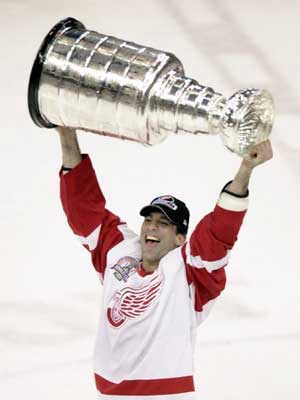
If part-time Badgers count, what about Crazy Legs Hirsch?

And, of course:
Ok, so Farley went to Marquette, but as a Madison native, we claim him as our own.
Subscribe to:
Posts (Atom)


